Interview with TGO Magazine Editor Emily Rodway

The second interview with an editor of a specialist magazine, offering some information and advice on breaking into the industry.

win_a_12_month_subscription_to_tgo_magazine_imagesgaryshipp_tgo_cover201210_smalljpg

1.How did you get into the industry?

I took a rather unconventional route into publishing. I studied at the University of Leeds and while I was there had a part-time job in a small commercial art gallery. When I graduated I was offered the position of Manager at the gallery. That role involved a fair amount of liaison with corporate clients so when I subsequently relocated to London, I took a job as an Account Manager with a specialist PR company. I wasn’t sure what I wanted to do with my career but the company I was joining published a number of magazines and I had edited my school magazine as a sixth former and was interested in writing and editing. Soon after joining the business I was offered the opportunity to try out for the magazines by taking home other journalists’ interview tapes and writing them up. I subsequently progressed through the department, eventually becoming an editor. When I then moved to Glasgow I took a job as Editor of a small publishing company that published three specialist magazines. I edited all three magazines and managed the small editorial and production team. But the main reason we had moved to Scotland was to be near the mountains and I was spending a lot of my spare time hillwalking, so when the job as Deputy Editor of The Great Outdoors came up, I was able to offer both hillwalking and editing experience. I was promoted to Editor of The Great Outdoors a couple of years later.


2.Describe your role?

I am responsible for the overall editorial content of The Great Outdoors – planning out issues of the magazine, commissioning freelancers and staff to produce features and photography, sub-editing, writing, picture research and proof-reading. One of my staff was recently promoted to Digital Editor so we work side-by-side on print and digital content.


3. What does your day to day work schedule involve?

Nowadays I don’t get out into the hills for work very often but I’m lucky in that the tasks I carry out at my desk are varied. However, keeping on top of my Outlook inbox can be a bit of a job in itself! I work remotely from the rest of the company so I spend a lot of time on the phone and on email, communicating with my team. I also spend a lot of time working on individual features and making them print-ready. I particularly enjoy that aspect of the job.


4.What skills do you think are required to do your job?

You need to be organised, creative and have good attention to detail. You need a fairly thick skin as people don’t hesitate to let you know if they disagree with something you’ve published!


5.Do you think a journalism degree or work experience/internships are more important?

I was lucky in that I managed to get into my job without either – although I did do some extra work at home for free in order to move from an administrative to a journalistic role in my first job in London. Sadly, nowadays things are a lot more difficult. When people approach me for work, I’m most interested to see evidence that they are keen on writing and interested in the outdoors. A good blog goes a long way! But obviously work experience, internships and a relevant qualification are all excellent experience too.


6.Best part of the job?

When a real gem of a feature lands in my inbox.


7.Worst part of the job?

Disgruntled readers – unfortunately you can’t please all the people all the time but we do our best.


8.How would you describe the job market for this area of work in the UK?

There aren’t that many outdoor magazines and most of them have very small teams. We use a lot of freelance writers rather than having a big staff.


9. Any advice for people wanting to break into the industry?

As I mentioned earlier, evidence of talent (good writing, good photography) and an interest in the outdoors go a long way with me. A great blog is a real asset.


10. Does working in an area that you love and was once perhaps your favourite hobby, take some of the magic away from the outdoors, because you’re surrounded by it all the time.? As in you can no longer use it as an escape? (It’s just something I worry about.)

It doesn’t take the magic away but it does mean that I’m sometimes drafting an article in my head while climbing a hill… I’m not very good at switching off work anyway – I’m sure some others are better at separating work and pleasure than I am!

Check out the magazine’s website for more information.

Interview with Editor of The Surfers Path, Alex Dick-Read

I carried out a series of interviews with people from the outdoor/adventure magazine industry recently to ask them advice on breaking into their world. They agreed to let me post up their reply on this blog to help others in a similar position.

The first is with the Editor of ‘The Surfers Path’ Alex Dick-Read.

Enjoy!

The%20Surfers%20Path_600_600_130311035719

1.How did you get into the industry?

Hard to know. When I was eighteen I went to the UK to work in a board factory and from that I met a load of people who, as the years went by, I realized were part of the core of the UK industry. So by the time I was asked to edit a surf magazine I knew a few people. Prior to starting the magazine I was working as a new/features journalist for AP and Reuters, so switching into the surf world again was strange but since I knew a few people, not too hard.


2.Describe your role?

I started the magazine, so my role has been everything from broad outline/concept creation to making tea and everything in between. In general it is all about soliciting, selecting and editing images and stories for each page. There is a lot of writing – even good contributors’ work needs editing simply to fit the page allocations etc. Plus captions, standfirsts, news stories, interviews, editorials, and all the elements within the broad architecture of a magazine. In recent years, website and social media have taken up more and more time. But overall, a huge portion of time is spent corresponding with contributors etc. and up keeping the web.


3. What does your day to day work schedule involve?

Starts with emails and that might not end until lunchtime or beyond. Website and social media stuff is integrated into that because so many emails involve links to films, stories etc that might work well on the website. So email and web stuff can take a lot of the day. If I’m lucky I get to start real editing work – writing, reading, choosing shots etc. – in the afternoon and I’ll do that until about an hour before dark, then go and surf.


4.What skills do you think are required to do your job?

Patience. Quick writing skills. Good communications, including politeness and respect to total strangers. A good eye for images and a good eye for synchronicity where ever it occurs. Sometimes you can be working on two things that seem totally different and suddenly you see a link or a theme that makes absolutely natural partners – perhaps shots on a page or stories you’re preparing for the page, or even parts of a story you’re editing that can unblock a piece and suddenly give it great flow. Things can become more than their component parts added together, if you can spot those lines.


5.Do you think a journalism degree or work experience/internships are more important?

Well, I did a post grad journalism diploma and intern work and they were both invaluable. Intern work is great because you’re in it, you’re meeting real people doing the real work and soon enough you know if it’s for you and if it isn’t. If it is, other people notice and you’re likley to get a leg up. Plus it just gives you real experiences to draw on. Degrees? They’re ok for some important stuff like law, shorthand, media theory etc. but not as essential as the job experience.


6.Best part of the job?

People. Waves. Perks.


7.Worst part of the job?

Low, low pay. Long, long hours. Super shitty, awful employers who treat you like dirt. They don’t surf. They don’t appreciate. All they want is a good bottom line and sometimes you end up fighting because of that.


8.How would you describe the job market for this area of work in the UK?

Is there one? It’s terrible all over. The surf media relies on surf industry support and the surf industry has been laying off hundreds of people and slashing budgets to almost zero. So the knock on effect to media is just brutal. The way to get work is to do good work and get it under the nose of an editor and keep doing it. But expect to be paid very little because that editor hardly has any budget.


9. Any advice for people wanting to break into the industry?

Keep the day job.


10. Does working in an area that you love and was once perhaps your favourite hobby, take some of the magic away from the outdoors, because your surrounded by it all the time.? As in you can no longer use it as an escape? (It’s just something I worry about.)

It works that way, for sure. But to be honest, the experience of surfing – of being in the ocean and becoming actively involved with it’s pulses – is such a visceral and powerful thing that it puts the job stuff into perspective. When you’re submerged in nature like that, the job stuff seems so minor and the here and now is all that matters. 99% of the time the act of surfing feels like a perk and actually makes the work side of it seem sort of … worth it.

Check out the website for more information on the magazine.

ALPKIT’S BIG SHAKEOUT

Published on sidetracked.co.uk on October 7th.

DCIM100GOPRO

When I was twelve, I wrote an essay in primary school. It was called, “A perfect summers day’. Today, the scribbles of my childhood climbed from my copybook and materialised before my eyes. It was all there. The backdrop of sun, tents, tepees, a temporary bmx track, smiling people pushing bikes, climbing walls, kids on their fathers shoulders laughing like lunatics. I walk amongst them on my own, a huge red backpack hugging my shoulders. Just outside the quaint little village of Ashford on the Water sat Thornbridge. A village so perfect it eerily reminds me of the film ‘Hot Fuzz’. This was the Peak District, curved and sloping hills, hijacked for the weekend by five hundred outdoorsy folk wanting to escape the city and breath in the country air. Alpkit’s Big Shake Out was in full swing.

The Friday night audience has the honour of spending an evening with adventurer Alastair Humphreys. A dummy wrapped in a bivvy bag, a hat and head torch sits amongst the audience. Al’s edits play in the background, a copy of his mapazine, ‘There are other Rivers’ sits on every chair. Humphreys is the absolute best for making mad expeditions seem in reach of everyone’s abilities; “All you have to be able to do is get on your bike and pitch your tent in the same day. Do that every day and eventually you’ll get around the world.” He was entertaining, spirited, reeling us in one by one, spilling out great lines like; “I had a huge support team of seven billion people that were ready to help me.” He has kids and adults alike oohing and aahing as he retells the stories of his Empty Quarter Expedition, his river walk in India, his microadventures.

Read the rest of this story on sidetracked.co.uk

A quick interview with Tom Denniss

A minute with Tom Denniss who has just completed the fastest circumnavigation of the globe on foot.

946160-tom-denniss

1.What was your daily routine while en route?

Wake up, breakfast, get dressed, run, finish the day, do the blog and other documentation, shower, dinner and red wine.

2.How do you plan to deal with the inevitable come down of stopping after that being your life for over 20 months?

Not sure – I’ll do the best I can.

3.What made you do it? Why not just keep running marathons and ultras?

It’s a great way to see the world. I am not interested in marathon or ultra races. I’m simply not capable of running them fast enough to be competitive (sprinting is my forte – 400 metre races). The world run was always at a slow and sustainable pace.

4.How did you convince your wife to commit to it as well?

She was keener than me.

4956144-3x2-700x467

6.How many pair of trainers/runners did you go through? 17

7.Was there ever a moment while on course when you felt that you could not do it?

No, although it was difficult at times.

8.How much of your success was dependent on mindset and how much was physical?

Probably 50/50.

9.What did you sleep in each night, tents/houses…?

Mostly hotels.

10. Why did you pick Oxfam as your charity?

I had donated to Oxfam for years, plus they have a history of fund raising events involving running.

11.How was the final day?

Short, but very enjoyable.

12. 26,000 km –  622 marathons. How is your body, especially your feet now?

I feel stronger than ever, especially around the knees and other joints. My feet were the only part that ached a bit by the end of each day, but that’s normal for someone who spends eight hours at a time on their feet.

402317

13. Did you succeed in it being the “Fastest Circumnavigation of the Earth on Foot”?

Yes, although I need to submit my documentation for ratification before it becomes official.

14. How your perspective on life changed as a result of this adventure?

I think I’m pretty much the same, except I now have a fantastic adventure under my belt.

Follow Tom’s adventures through his facebook, Twitter or blog page.

Interview with David of the 5000 mile Project

David and Katharine are 13months into running the length of South America. 5000miles through rainforest and mountains to raise both money and awareness for the environment. I got in contact with Dave when he emerged from the rainforest for a brief spell to hear about their amazing story so far.

David-Katharine-Running-Bolivia-21

1.You ran to raise awareness and get people passionate about nature again, do you think it has been working?

Ha, that’s a tough one to start with! I think it depends on what level. Locally, when we stop at a school midway through our running day it is a fantastic opportunity to inspire – it’s easy! We are there with people, we are enthusing about the natural world around us, we have images and video and feathers we find by the road to identify and the feedback is immediate, people are psyched! From afar, who knows?!

People are used to sporting events been used to raise money for cancer or other human-related causes, not wildlife. The publics reaction can depend on class and country, but generally speaking most people are resistant to anything that they see as an attack on their current way of life – it’s the human condition. We are saying, “look out the window, the natural world is utterly amazing”, people are hearing, “these guys are greenies trying to make it more difficult for me to have a big car!”

Also, depending on the media,  feedback isn’t immediate, in fact with some forms of media e.g. radio, you never receive it! So its hard to tell.

2.What do people need to do to help?

It’s easy, have an affair with nature! People of any physical condition can do it – go out, be in the real world, be amazed by the complex natural systems that support human life, ask questions, investigate, learn that we are part of nature, not above it! We are passionate that so long as people know more about the natural world’s secrets, there is a chance that we can reverse the damage we are currently inflicting on out planets life support systems.

To help people find tangible actions that suit their lifestyle, we’ve set up a campaign with ‘DoNation’ which anyone can join and help do cool things for the planet. We’re also raising money for Birdlife and Armonia and Conservatcion Patagonica.

3.What running experience did you have before this?

We are both keen recreational runners, no more than that, with the odd longer competition under our belt. Kath has ran the 45 mile ‘4 INNS’ race several times. I have enjoyed the Scottish Islands Peaks Race, and Northumberlands Castles and Islands, both sailing/running events, but mainly we run for the fun of being outside in all weather.  Nothing better for de-stressing!

4.How are your feet withstanding this?

Really good, I haven’t had a single blister! We have a nice combination of shoes for running with the trailer and running free, plus we go barefoot about 10% of the miles now – its great for training your running style and hardening the feet a little.

5.What distance do you cover on average per day?

Our average running day is now 23miles. We used to find 20 was enough, given the 80kg trailer we run with, and given the fact an injury could end our dream, but now we can smell the finish we are looking to take a few more risks to squeeze a little more out!

6.How do you keep your mind focused and your spirits high after so long on the road?

It’s better not to consider the overall distance remaining – just deal with each shift as it comes, each half hour, each mile, each step if it’s a really tough climb! Each step makes a difference, and we have taken close to 10,000,000. It´s a nice metaphor for the steps people are taking to protect the planet too, 1 in 7bn is daunting, but there is no silver bullet, each small, seemingly insignificant step is making a difference!

7.Any stories of good deeds or amazing people you’ve met along the way?

Many! We are alone a lot, but never far from human kindness. One thing I would say is that the place in which we received the most charity by the roadside; food, drinks, shelter, banter, is Bolivia. What is interesting is that Bolivia is the poorest country in South America!

8.What advantage have the barefoot shoes given you?

They are great. The idea is always to run as naturally as possible at all times. On certain road conditions (or with the trailer!) you simply can not do it with bare feet. The gravel makes you wince or you have road debris, or the asphalt is so hot it sticks to your skin. We slip on the barefoot shoes and we are back on, running lightly with a quick cadence. We change our shoes a lot!

Working-from-the-road1

9.Have you came up with an effective way to treat blisters yet?

Yes! Our INOV-8 race socks have basically all but eliminated them. We are not paid-up athletes so are not obliged to say this, but they work. They are single skin socks and with our INOV-8 and VIVOBAREFOOT. I  have not had a problem in over 5000miles of running in rain, wind, and snow. Barefoot running probably helps too as it hardens your feet.

10.How have you seen your fitness change?

I have no idea when these calves arrived, but they did! We have improved greatly fitness wise, but still there is never an easy 23-mile day running whilst pulling a heavy trailer, sandwiched between other longer running days!

11.How much food and water do you carry on you?

Good question, it varies wildly. We carry the minimum possible whilst making sure we never go hungry. In the more populated areas that could be 2 days worth, maybe 3kg. On the wild stretches (we have carried food for 21 days)probably 100kg! We eat local food and do not use bizarre packet foods which are expensive and unavailable, and seem to me to just taste of stock cubes.

Water, again depends on the territory. We drink a lot, usually 10L each per day, so that’s 20kg water per day on the trailer when we are in dry areas. Good to remember that dehydration is a major cause of running injuries so not to be messed with. In Chile and here in the rainforest we can carry very little as it always available. In Argentina water was the limiting factor, and at times we carried over 30 litres. We use a LifeSaverSystems water filter to pump and clean wild water where it feels like we need to, but this does take valuable running time (and calories!).

12.You have been running for over twelve months, when is the expected date of completion?

20th October 2013, not a day later!

Courtesy of Miky Dubrowsky of www.mediamza.com
Courtesy of Miky Dubrowsky of http://www.mediamza.com

14. What is the coolest animal you’ve seen on route?

I love Guanacos, it´s like a sexy version of a camel with long eyelashes! Best bird moment? An Amazona Parrot landed on Katharine´s shoulder a few days ago whilst we were running past the rainforest. Sounds silly, but we asked it what it was called and it said “Laura”. It’s true! Mind you, it said Laura to everything, whilst nibbling Katharine’s ear.

15. What are you using to navigate?

Garmin Forerunner 310XT GPS watch plus google satellite images. Each charge lasts us two days now, and we can charge it with the PowerMonkey solar panel easily in an hour. It’s very good, but I wouldn´t swim with it on as the seals are going, we are really using our equipment!

16.What are you finding the toughest to cope with?

Living by the roadside – it´s sort of a mix between local celebrity and being a tramp! We try to hide as best we can when we are not running but it can be really tough, not having somewhere to call home.

17.How are you getting on with each other after so long in each others pockets?

Can you imagine it?!  We are friends as well as husband and wife, and running partners, but at times we flare up!Sometimes the whole of South America wouldn’t be big enough, and we yell in the wind! Naah, like all relationships we tend to focus our angst on the ones  closest (especially given there is nobody else who speaks your language within 5000miles!), especially when hungry and tired, but we are normally too tired to remember what the thing was all about! What normally happens is some wildlife moment or other gets in the way of our mood, and we end up saying ¨wow, what the hell was that?!¨.

18. What’s the best piece of gear you have brought?

INOV-8 wrags! It is a little piece of fabric that we cannot live without! They protect us from the sun, wind, dust, rubs in a myriad of places best left undisclosed!!

Follow the pairs journey on their website, twitter or facebook page.

Thoughts while walking the Wicklow Way

The Wicklow Way. If you are in Ireland or you are on your way, you must do it. Uphill, downhill, views that make you shit your pants, waterfalls, silence, drinking out of streams, no crowds, no people, so few yellow arrows that you are bound to get lost….132km of the fairytale Ireland that you thought only existed in the mind of an eager American tourist.

ww4

I am on it as I write. I don’t know where abouts, somewhere between Glendalough and Clonegal, there is no people here. No signpost or no coverage so I cannot find out. I have a feeling that I walked over 30 kms today, but I have no way of proving it, only to show you my weeping feet. We are camped beside a slowly churning river, my friend and I, in a dainty borrowed green tent. We are hidden from view by the trees . I sit while my friend naps beside me on his poncho.

Look at us. Envy us. For our existence is so simple. We ate baked beans and a hot pot from a packet for our dinner, a galaxy bar halved for dessert. We washed the pots, our feet and our faces in the river and now we sit in silence, just listening and thinking. How can anyone be unhappy when they have the ability to live like this. And everyone does, you don’t have to be clever, athletic, beautiful or rich. You just have to want, you just have to stop with all the bullshit. Step away from the drama and the expectations. You have to stop with the fear, the doubt, the excuses. Trust me, life is a lot easier out here then it is where you are, sitting in front of a computer screen in your warm house with all your bills and worries and unticked bucket lists.

ww5

Alas, the night swept in. The condensation crept up the walls of the tent and began to drip. I put on more layers, another pair of socks, a woolly hat. I curled up in the foetal position and all was well for about ten minutes and then I was cold, really cold and wide awake for the next seven hours. It took a few hours of plodding along the following morning for my spirits to climb back up and get on with it. Which begs the question, although my mind has decided what I want to do with my life, is my body built for it? Can gear compensate for a body that has to sleep in a dressing gown indoors in the middle of August?

At least I’m trying I suppose. How many people aren’t?

Fear

dad

Fear was always a foreign concept to me, one I didn’t really understand because i  never felt it as hard as most people do. I didn’t much like frogs or veins, but they were irrational and I knew it. Fear was never an inhibiting factor because it didn’t enter the thought process in anything I did. But it has leaked into my life of late. Things I used to love are making me uncomfortable –  I have not enjoyed the feeling of seaweed grabbing my arms and legs as I swim in the river or the usual feeling of adrenaline that goes with longboarding down a  big hill. I have had to talk myself into letting control over to the mountainbike beneath my legs as i force myself to push it down a mountain and I have not written for fear I will write nothing worthwhile. But what has really slowed me down is the fear of failure. Failing at a career I want so bad and failing to get all I want to do done before my time runs out.

At twenty one years of age I feel burnt out. This is not the me I know or want to be. I don’t want to question why I am signing up to do a triathlon or a marathon or learning how to ride a motorbike. I just want to do it. I have a quote engraved on the back of my Ipod; “There is nothing to fear but fear itself.” It is my favourite quote, a mantra I continually repeat. But what happens when the fear is beginning to overtake and consume. How do I get back on track to who I want to be and the life I have already signed up to lead?

Camino de Santiago – Porto to Santiago 230km

Two pairs of socks pulled on over my iodine soaked and plastered feet. Runners stepped into swiftly – the faster I do it means the less pain I must endure. Laces looped and knotted up. Backpack thrown over my sunburnt back and clipped into place. Poncho and jumper hanging over the straps. Cap pulled down over my face. Step one, step two…..walk.

213km is our aim. We have seven days before our flight takes off back to Dublin, with or without us on board. We are two twenty-one year old girls with no religious motivations. We will walk the Camino de Santiago pilgrimage from Porto in Portugal to Santiago in Spain.

Here are some thoughts from the road.

Step one thousand, step one thousand and one….

Up at half five or six every morning to walk out into the rain. Greeted by rolling green hills, orange tiles, ceramic paths, terracotta flower pots, beautiful ruins, bags of cut up fish, overgrown plants engulfing Portugal’s attempt to modernise, cracking tarmac, beautiful architecture, wrinkled and tanned faces. This is Portugal. No phones, no wifi, thinking, laughing, getting lost, finding your way, the constant smiles from strangers, no makeup, no hair dryer, no hair straightener, no mask to hide behind. No distractions. This is me.

This little adventure of ours is a stepping stone into real expeditions, one with a safety net of yellow arrows and hostels to cocoon you if you panic or mess up. My walking companion Eimear lacks a sense of direction and map skills, I’m only a little better. It is a taste of the realities of what it could be like in the real world of adventure. Yet I cannot but be grateful for her presence, I would be lost in all other senses of the word, without her. Then it is the choice of tent or hostel – one room housing  40+ people, which looks like a workhouse or a hospital in the middle of a warzone or the solitude of a tent which we would have to carry on our backs. We opt for hostels this time. To everyone around we are ‘the crazy Irish girls’. In xxx -large rain jackets which we purchased off a mechanic on day 2, carrying no sleeping bags, getting excited by different flavoured callipo ice pops ,carrying tiny backpacks, wearing runners instead of hiking boots, shorts and t-shirts from Primark, no walking sticks, singing all the time and walking fast, really fast. We are here to wing it and succeed. We have no profound reason for coming. We just want to walk.

cammm

Each evening  we enter a hostel full of older men walking around in their white cotton panties, we sprint to get into the group showers first so we can bar the door shut before other naked ladies arrive. Eimear and I are no exception to the Irish fear of nakedness , we time grabbing our clothes so we do not glimpse each other in the nude – it is synchronised showering. After the shower we massage our heel calluses and calves, thread and bandage our blisters and climb onto the plastic covered mattresses to try to fall asleep before the snoring opera commences.

Sometimes we find ourselves lapsing into a comfortable silence, taking pleasure in the simple things. In the ache of every step, in the noise pressing in on us from the constant cock crow, to the church bells chiming, to the click, click of others walking sticks. We embrace the utter joy of taking off our runners and letting our feet breath , watching them spread out and reshape like the scientist in ‘Xmen: First Class’ who has more than five toes but squishes them into a normal pair of shoes every day.

On day 4 we cover 43km by accident, as a result of some bad directions and our lack of Portuguese. It was too much. The last 5km I was a hobbling mess, nursing six blisters on my left foot and four on my right. We cross into Spain and hardly register it. That day we had walked over a mountain in the first 18km, stood in a stream in our runners to sooth our aching feet, shed a few tears and called home. When all seemed lost, I receive a tweet from a friend of mine – ‘congratulations on completing your first marathon!’ – Boom, step ten thousand, step ten thousand and one…onwards we go.

santiagooo

Bon Dia, Bon Dia, Bon Dia, Bom Camino… the people here have wowed me. There was the girl on the metro who rang her friend to translate directions for us. The boy who asked us if we wanted to sail along the coast of Spain with him. The guy that saw us pushing ourselves slowly up a hill, passed us in his red van, slowed down, did a u-turn, came back and passed us a hot french baguette out the window of his car. The man who gave us two shells – the symbol of the Camino.  The old women waving from her patio and blowing a kiss. Two Americans – father and son doing the pilgrimage together.  Adam the wise Polish legend who is on his seventh Camino. The two Germans Christine and Jan each here for personal reasons who have joined our entourage and together we four will reach Santiago.

Eimear is gaining speed while I am starting to slow down.  But we are a team, and the slower pace means we get a chance to appreciate a country, it’s easy going lifestyle and its people. Day 6 – 32km. We discover a little hot springs fountain – Eimear takes off her shoes, she has tan line for the first time ever just above where he sock sits… it turns out to be dirt. Apparently if you drink the water of the fountain you will be married within the year. Christine proceeds to knock it back. Me, Eimear and Jan take a rushed step backwards. We take ninja pictures along the way, have light saver fights with the walking sticks, I pull the petals from the foxgloves that line our path.  Each morning we rise and make porridge for breakfast, the four of us functioning like a family, sharing everything, taking turns, rubbing in sun cream and fetching water.

santiago

The last day has pounced upon us, one last 32km stroll. We take it slow, stopping for lunch at an outdoor bar in the middle of nowhere, a Swedish man plays the accordion, there are men letting off fireworks in the day time, I am drinking coca cola and eating my last Spanish omelette. The four of us walk into Santiago. No fuss is made, no big celebrations, a group hug and then we get ice-cream and sit on the ground in front of the cathedral. It is sunny for once. Around us others celebrate their finish.

We did it.

One lesson learned.

I can do this. I can do anything.

Polarbears and Paddleboards

First published on Sidetracked online.

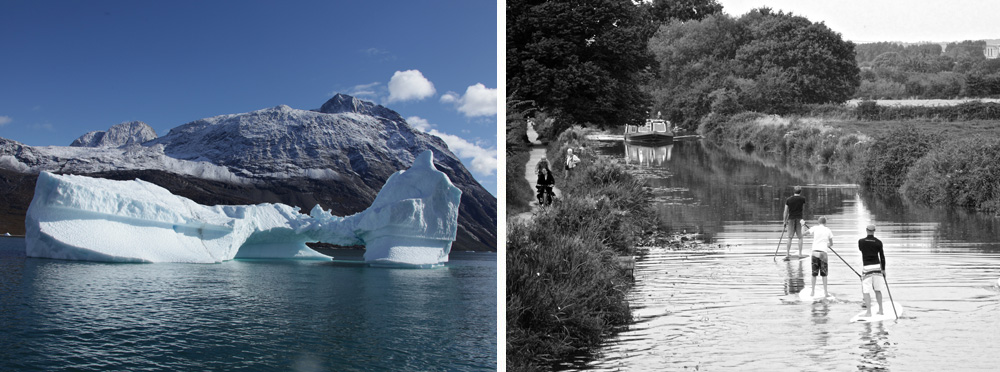
PAP-Greenland-04

Ideas for unique adventures to embark on are becoming increasingly difficult to unearth. However, we think we’ve come across such a one. A team of ten will attempt to Stand Up Paddleboard up the Sermilik Fjord in Greenland to reach the towering Helheim Glacier. A 100km journey that has never been attempted before. Sidetracked caught up with team member Phil Sayers to find out how they intend to pull off this feat.

Sidetracked: So how did you get involved in all of this?

Phil Sayers: Paul Hyman and Justin Miles originally came up with the concept of taking Paddleboarding to an extreme and remote location like the Arctic to prove how safe and accessible Stand Up Paddleboarding is. The idea for the project evolved over the following months and once they mentioned the project to me I knew that this was an adventure of a lifetime and immediately said that I would love to be a part of it. The expedition is an opportunity to visit one of the most stunning landscapes on the planet; the project also has the potential to help change lives through the charities we are supporting and introduce new people to this exciting new water sport that we are all so passionate about.

Have you been trying to replicate the conditions of Greenland in your training? E.g. going out on your board in speedos so you can get used to the cold?

The UK weather has come up trumps over the last few months for providing conditions similar to what we are expecting to find in Greenland. We anticipate the water temperature in August to be around freezing and the air temperature to be between 5-10 degrees, so the extended winter conditions have been ideal.

SUP is quite an exposed way of travelling, what gear will you be wearing in case you fall in to the water?

We are currently testing a variety of clothing and equipment to take on the expedition including; dry suits, base layers, wetsuits, wetsuit socks, dry boots and various gloves and mitts. The main factors that we need to consider are: keeping our feet warm as these will be in contact with the water for the majority of time; and selecting clothing that will prevent us becoming too hot while paddling, but at the same time ensuring we are protected in case we fall into the freezing water. The training and expedition will give us the opportunity to find out what water sports kit works well in cold conditions and if there is a need for developing new clothing and equipment to ensure people are able to paddle all year round. We will be working closely with manufacturers to help develop equipment specifically for the SUP market.

Read the full interview on Sidetracked’s website here.