Interview with @womenwithwaves tweeter Edward Glass

Though he does not surf himself, the guy knows his stuff, and is one of the few who chooses to document the world of female surfers over the males. We talk about the ever growing women’s surfing industry.

1.Why do you think the sponsorship for female surfers is so lacking in comparison to the men’s?

I wish I had figures on the state of men v women sponsorship. The number of women surfers worldwide is around 15% to 20% of the total, and is growing, but I have no idea as to the sponsorship details. I find it a sad reflection on surfing when I know that two of the women on the 2012 world tour do not have a sponsor. Those women being Paige Hareb and Bec Woods.

2.How do we get more women involved in the sport?

I believe that more girls and women are becoming surfers but a stumbling block may be the costs involved. Boards and wetsuits may be out of a lot of parents budgets.

3.Do you thing there is still a gender bias present in surfing?

At present there is a gender bias which to my eye becomes apparent when I watch webcasts. The professional women always have to play second fiddle in the event order and I believe they would slip down to third-place billing if dolphins could be trained to surf competitively.

4. Surfer mag has recently launched a magazine geared exclusively towards women surfers; SALTED. Is this the future? Will others follow suit?

Yeah! Great to see an all-women surfers magazine out there now. Hopefully Salted magazine will be the first of many quality women’s surfing magazines.

5.What has the UK got to offer the surfing world?

The surfing scene in GB or UK (something to do with the channel islands, I believe) is trying its best to generate professionals, both men and women, but our waters are not exactly up to the standard that is available to surfers even as close as France.

British surfers, to improve to a quality level would have to leave here.

6.Who are your surfing idols?

Simple! Bethany Hamilton is the surfer I adore. If the shark attack had not happened then I would have no knowledge of surfing whatsoever. If Bethany had not returned to competitive surfing in 2004, then I would have just been pleased to know that she had survived and was leading her life as best she could. I could add many names to a list of ‘surfing idols’ but I won’t.

7. Do you think the big brands such as Roxy, Quicksilver Ripcurl etc could do more for the female side of the industry?

Difficult one. The big brands need the surfers to promote their brands, but is it enough ? All the companies would cite the state of the world financial markets for them pulling money out of surfing.

I will be keeping a watchful eye on the financials for 2013 and deducing whether the big brands are doing enough for the professional women.

8. Why is it important to you personally to document the female surfing competitions?

My love for surfing began with a girl, has grown via a quality batch of highly competitive women surfers and I just love the competition between them. I occasionally watch the men, but I would choose to watch the girls over the guys, every day of the week.

9 What’s on offer for women surfers outside of the ASP world tour?

Behind the main world tour, there is the ‘Star Series’ where the vast majority of the women compete in, trying to gain places on the world tour. Also, there is the Junior girls world tour. Here in GB, there is the UK Pro Tour (that GB & UK thing again)

Follow womenwithwaves on Twitter @womenwithwaves

“4 men. 1 ball. 300 miles.”- This is Jog4Hampden.

Published in the Journal – Edinburgh Student newspaper – 14/09/12


A young man once said; “You only ever grow as a human being if you’re outside your comfort zone.” This learned man’s name is Stuart Doyle and this particular man practises what he preaches. He and three of his mates have just dribbled a £3 Sondico football 300 miles from John O’Groats to Hampden Park in Glasgow.

One ball controlled by four Scottish men; Andrew Milne, Chris Strother, Mark Graham and Stuart Doyle. Each taking it in turns for 15 minute shifts they successfully guided the ball across the beaches of Brora over the West Highland Way and through Clyde Valley to arrive at their final destination.

The distance plus time limit covered in this challenge is equivalent to running twelve marathons in ten days. A feat that requires serious training and a fondness for pain; “We have trained off road a lot and tried to replicate most of the route conditions we will encounter along the way so we are prepared. I have also incorporated a mix of cross training like football, swimming, strength conditioning, mobility and flexibility stretching;” says 29 year old Doyle.

Like all true adventurers, the boys are camping. Before they embarked on the challenge, Doyle explained why they made this decision; “We will be wild camping each night as this gives us the most flexibility whilst also the most manly feeling! We are all outdoorsy guys so camping isn’t an issue, the midges might be however. But the reality is we will be out in the middle of nowhere so camping is our only option most nights!”

And like all good boys, they have undertaken this task not for themselves but for a charity; Tartan Army Children’s Charity. A charity which supports disadvantaged children in Scotland. “It was an easy choice, they are a great charity doing wonderful things and have given us their full support,” says Doyle.

The scale of this challenge meant the four would suffer. The pain and the injuries in what has been coined “endurance dribbling” was an ever present worry. Stuart Doyle endured the miles with swollen feet and a dodgy knee, while Mark Graham struggled with inflamed tendons. However another fear outweighed their ailments; “I think the fear of not doing it is the key,” was posted on the Jog4Hampden Twitter page.

They ran for ten days straight, directions courtesy of a detailed map and several iPhone’s. They roll into the national stadium in Hampden on the 8th of September in time to support Scotland as they kick off their World Cup qualifying campaign.

Doyle’s parting lines were; “Maybe we will start the urban dribbling craze that may sweep the nation in 2013.” People can give to the cause on their Just Giving page: http://www.justgiving.com/jog4hampden. You can also text to donate by texting JOGG67, followed by your chosen amount to 70070.

Interview with Mountain Guide and Mountaineering Instructor James Thacker:

1.What age were you when you started climbing mountains?

I first started walking with my parents when we moved to Derbyshire in my early teens.  We spent most weekends exploring the moors of the Peak District and later climbing on the grit-stone edges.  My parents despite being active weren’t walkers so we started together really, learning to navigate and look after ourselves on the hill.

-What was the first mountain you climbed?

Most likely Kinder Scout in Derbyshire, but the ones I most vividly remember are Tryfan in North Wales and Ben Nevis in the Highlands.  Tryfan was particularly exciting as it involved a lengthy scramble up the north ridge and I had never experienced anything like that before.  Ben Nevis I also remember as we turned back from fairly close to the summit in bad weather, we were worried about the large cliffs of the north face in bad visibility.  Turning round was a good learning experience an something that might be essential on any mountain.

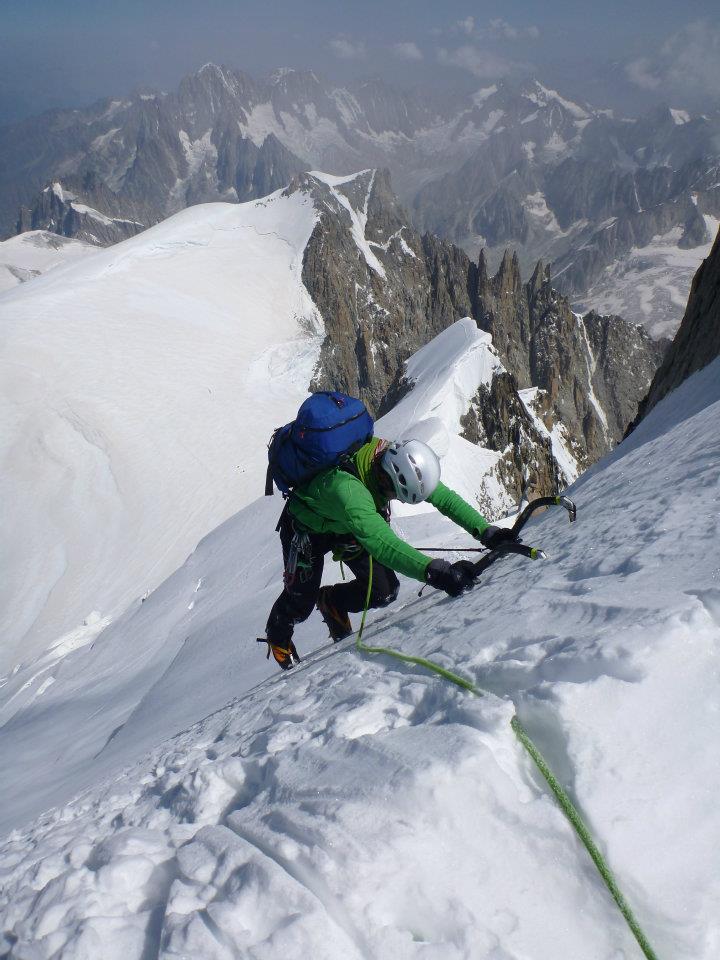
Mont Blanc du Tacul

2.What are the most impressive mountains you have climbed?

Argh, hit me with a difficult question there.  This is a tricky, I guess for me I like the variety so it’s nice to climb summits in Derbyshire, remote Scottish Munros and peaks in the European Alps.  The ‘Steeple’ in the Lemon Mountains of East Greenland stands out as one of my best achievements, it’s fairly low and technically relatively easy by modern standards but is very remote.  I climbed this route in 2000 on an expedition to Greenland with some friends, all in their 20’s at the time, making a number of first ascents including the Steeple which had been attempted previously by Chris Bonington.  22 hours after starting we were back at our skis having climbed a fantastic icy couloir line aided by the “midnight sun” of the Arctic Circle.  Some seven or eight years later I went on to climb the North Face of the Eiger in Switzerland with Nick Wallis, a route with a considerable reputation and standing out as a definite high point for me.  Firstly, because of the route and secondly getting to share it with Nick – we had a great time and everything went well which was great as we had bumped into each other in Chamonix randomly.  It just felt right!

3.Any good stories of danger to share with us?

By choosing to visit the mountains we all expose ourselves to greater risk that is always present.  Certainly for me part of the appeal of climbing is trying to minimise this risk as much as possible.  Being adequately prepared, checking the weather and avalanche forecasts, choosing the right route and partner are all really important.  But inevitably some things are out of your control, or sometimes you just overstep the mark.  Getting avalanched in Greenland, was a massive learning experience, nearly getting hit by a collapsing ice fall in France meant I learned a bit more…

4.Why did you go into mountain guiding?

I always wanted to be a fighter pilot to be honest!  Having got as far as doing my aircrew selection for the Royal Air Force, I realised that the shortest contract I could sign up for was eighteen years and I was eighteen at the time.  To start such a career at the time just seemed inconceivable so I chose to go to University to study Geology instead.  Going to University in Sheffield I inevitably met some really keen climbers and decided pretty soon that I wanted to climb professionally.  As a teenager I had been on a climbing course at my local outdoor centre, the course being run by a British Mountain Guide – this was a really positive experience and the first time that I realised that there were people out there who could take you to amazing places or reach elusive summits.  

5.Whats next on the list to climb?

Today I am checking the weather forecast to see if I can climb Mont Blanc over the weekend.  I then have a week with a friend and regular client Martin, we are yet to decide on exactly where to go – but we could go anywhere and thats the beauty in guiding with a person you know well.  Later in the year I am off to Ama Dablam in Nepal.

6.What needs to be done to save our mountains of the world from problems such as litter, etc.?

As individuals I think we just need to be a low impact as possible when visiting the mountains.  That might mean taking your litter home or making sure that you employ local porters and kit them out properly at the other end of the scale.  The danger is that people fail to even give it some thought.

Abseiling on Creag Meagaidh

7.How many times a week do you get out yourself on the climbs or are you mostly a man of the office now?

I am better at climbing mountains than sending emails, so I am usually out working whether it be in Derbyshire, Scotland or here in the Alps.

8. What are the most popular climbs your company offers?

Most of my work is done at fairly low ratios (i.e. one or two people) and is pretty flexible in it’s nature.  As a result I get to go to lots of different places and do different things.  Of course some climbs, summits or itineraries are more popular than others so I often find myself on Ben Nevis winter climbing, on Mont Blanc or in the Swiss Valais for example.  This year I have already got some requests to go Ice Climbing in Norway, rock climbing in the Lofoten Islands and mountaineering in Nepal…

9.Is there a particular big or difficult climb that you really want to do in your lifetime?

I have always wanted to climb the six classic North Faces of the Alps: The Eiger, Matterhorn, Grandes Jorasses, Cima Grande de Laverado, Petite Dru and Piz Badile.  I have done four of the six so the remaining two i.e. Colton/MacIntyre on the Grandes Jorasses and the Schmidt Route on the Matterhorn.  The Colton/MacIntyre was climbed in 1976 by British alpinists Nick Colton and Alex MacIntyre and remains a classic and highly saught after prize today.  By chance I bumped into Nick Colton the other day and was dying to ask him (again) about the story of the first ascent.

10. What do you bring with you on a long climb?

On a big route, quite simply as little as possible.  The lightest equipment is the stuff you left behind.  On big alpine routes there are a few things that always go with me, the first is some abseil tat (i.e. cord) and a knife incase I need to retreat.  The second is a MacDonalds straw – sometimes these can be really useful for collecting melting snow which saves on the amount of gas you might need to carry.

11.What brand do you think offers the best quality mountaineering gear?

Well I have been supported by Haglöfs and Edelrid for a while now, both of whom make very good clothing and equipment which I would now find difficult to be without.  The reality now is that the mountaineering market is so competitive that bad equipment or brands just don’t flourish or even survive.  The result is that we have so much good gear available now to make our lives easier (or more comfortable) on the mountain.  I’m glad to have been a small part of that by providing product feedback for Haglöfs and Edelrid.

12.What does the UK have to offer the mountaineering folk worldwide?

The UK has a great mountaineering pedigree.  We are used to putting up with bad weather and making the most of it, and sometimes just toughing it out a bit with a slow and stready approach.  That results in British alpinists having a really good expedition record in the greater ranges but also an ability to miss the telephriques in the alps and get benighted!  The British Mountaineering Council run a popular Winter Climbing International Meet in Scotland every two years and climbers from around the world are always amazed at the Scottish weather and the climbing.

13.Its a pricey sport; how long did it take you to build up equipment stocks when you first started?

It can be expensive, but so are golf clubs, paragliders etc!  One of the best things about climbing is that you can participate at different levels.  I started out bouldering and soloing on Derbyshire outcrops with a chalk bag and a pair of rockshoes (now probably available for £120) max.  Other kit can then be built up as you go along, and or be split with a climbing partner.

14.Did you ever have any accidents while out on a climb?

No yet! But I did badly break my leg skiing.  

15. What is the average age group of your clients?

I have worked with everybody from 12 years – 65+ and age isn’t a barrier to climbing really if it’s your thing.  Most clients are 35-50 I would guess.

Mont Blanc de Cheilon

16. Is fear still a factor for you after so many years experience?

Fear, yes definitely.  Ultimately, fear is what keeps us safe.  I think you become better at managing it and deciding whether it is rational or irrational and then getting on with the task in hand.

Check out Jame’s website and Twitter @jamesthacker.

Interview with Jog4Hampden runner Stuart Doyle

1.Explain what you aim to do?

We are simply running 300 miles from John O’Groats to Hampden whilst dribbling a football. We aim to arrive on the final day at the National stadium to watch Scotland’s opening 2014 WC qualifier.

2. Is it one ball to dribble between all of you or one each?

Yes we have one ball that will be constantly on the move, moving between the four of us at different times (15 minute shifts.)

Stuart Doyle

3. Who does the team consist of?

The team consists of myself:

Stuart Doyle 29 (Something dull in pensions) – The gaffer

Andrew Milne 33 (student..that’s right a 33 year old student) – Route master and most likely to spew

Chris Strother 33 (Edinburgh’s top Barista) – award winning footballer

Mark Graham 25 (EcComerce whiz) – the baby of the team and a heartbreaker

4. How did you come up with the challenge?

It was something I had initially thought about back in 2010 but opted in 2011 to take on a European cycle instead of this challenge. So naturally when thinking what to do this year it was the obvious choice. My initial thoughts were to take on a long challenging run but with a bit of a twist…then the idea of dribbling a ball popped into my head. It’s not something I had heard anyone doing so thought it would be fun and challenging.

5.How do you all know each other?

I play football with Chris and have known him for many years, I met Andy through football and I work with Mark. Knowing all 3 guys I knew it would be a great team bringing them all together and this has been proven while training. I’m not sure I would want anyone else by my side as we take on this challenge.

6.What has your training consisted of?

As you can imagine lots of running! We have trained lots off road and tried to replicate most of the route conditions we will encounter along the way so we are prepared. Running with the ball proved to be less of a challenge than we anticipated but we can reevaluate this statement come the west highland way!! I have also incorporated a mix of cross training like football, swimming, strength conditioning, mobility and flexibility stretching. The stretching will be key for our recovery at night and the mornings.

7.How do you plan to navigate?

We have each day mapped out in detail so will be using maps to prep for each section across the day. Oh and the iPhone.

8.Are you going to document the trip as you go?

Yes as a team we plan to blog or micro blog as much as we can. We will be using social media daily to keep people updated. I will be filming the run and recording vocal blogs on AudioBoo to capture as much of the immediate thoughts and feelings as possible as its key to capture these feelings before they become forgotten with the relief of finishing each days run.

9.When’s the start date?

We start our run on Thursday 30th August and finish at Hampden on 8th September.

10.Where are you going to sleep at night?

We will be wild camping each night as this gives us the most flexibility whilst also the most manly feeling!! We are all outdoorsy guys so camping isn’t an issue, the midges might be however. But the reality is we will be out in the middle of nowhere so camping is our only option most nights!

11.Why did you choose Tartan Army Children’s Charity?

It was an easy choice they are a great charity doing wonderful things and have given us their full support. Also the supporters and trustees are phenomenal people as all involved are volunteers giving up their own time to help others.

12. How many back up footballs are you taken?

Well we have 2 balls and intend to use just the one the whole way!! We will see….

13. Have any of you taken on a challenge like this before?

We have all been involved in challenges and events over the last few years but as for “endurance dribbling” this is a first for us all.

14. What’s the entertainment on route….ipod, singingetc.?

I think everyone has packed headphones but the general consensus is that we will all be keeping each other entertained and the morale high with our expert banter 😉

15.Any side effects to all this running….injuries, reduced time with families etc?

We have all had our fair share of niggles and the like but Mark probably had the worst of it after our 47 mile run suffering bad ITB band swelling and pain for a good couple of months! Personally I have not been able to train properly for the last 3 weeks due to a football injury but I guess it’s not the worst timing as I would generally be tapering my training anyway. As of now we are all pretty much fully fit and raring to go.

16. Have you thought ahead to life after the challenge. Perhaps another adventure?

Oh I’m always planning ahead!! I think I will be doing a lot more smaller scale challenges next year, but that’s not to say they won’t be as exciting and challenging.

17.Whats packed to carry with you on route?

We will be carrying a small running belt with the essentials whilst running and our support van will meet us along the way and at the end of each day allowing us to refuel when needed.

18. How do people donate to the cause?

People can visit our Just Giving page www.justgiving.com/jog4hampden

You can also txt donate by texting JOGG67 then your chosen amount to 70070.

19. Do you have a support team coming along?

Yes we have a support Van to help us along dangerous parts of the route when we need to be on the larger busy roads and to carry all our camping equipment and food.

With 4 days before before we set off we lost our driver for the first 5 days but luckily a hero by the name of Ronnie Maloney stepped in and agreed to drive the first half of our adventure! Another legend by the name of Stephen Milne will then take over on day 6 to guide us to Hampden.

20. Is there a big difference between doing it with a football as opposed to just jogging it?

Yes and no! Along flat roads and paths it’s not to bad to be honest but when we start getting to the off road sections and when we start tackling the hills then it becomes a whole new experience. We have been out on the pentland hills training off road so we know what we are in for.

21. Has it ever been done before?

I believe there are some sort of records for a relay type affair where the ball is dribbled for so long and passed to another person and this has been done over a very long distance, but I’m unaware of team carrying the ball together over such a distance and terrain that we are going over. Maybe we will start the urban dribbling craze that may sweep the nation in 2013.

To follow the Jog4Hampden boys, check out their website or Twitter @jog4hampden

Interview with American kayaker Ryan Dolan

Claim to fame:

National Kayak Team Member from Hawaii.

2011 Pan American Games Bronze Medalist.


1.What is it that first attracted you to kayaking?

I was in highschool and had already been doing lots of outrigger canoe paddling in 6 mans and 1 person boats and my older brother Pat was a US National Team Member already so lots of people were encouraging me to do it. My good friend Stuart Gassner really helped me get going and made it fun. Initially it was just something to try and help cross train for Outrigger but then slowly it became about beating the guy who was faster or better and then I realized I really enjoyed it and got introduced to the Hawaii Canoe and Kayak Team and sprint kayaks in 2008. I decided I wanted to really persue the sport and try to make the Olympic Team.

2.Is there anything thing in particular you love about it?

I love being on the water and making a boat move through the connection of your body and muscles. I also really enjoyed the speed and smoothness the boats had. It’s a very addicting sport that made me and keeps making me obsessed to get better and faster.


3.Do you have any other hobbies?

Growing up in Hawaii I also have loved watersports. I love to fish when I have time, but it really comes down to just paddling. If I am not kayaking I enjoy going back to my roots of Outrigger canoe paddling and surfski paddling in the ocean. Paddling in the ocean can make me really relaxed and forget everything else. I am also into learning about and building websites. It’s a new hobby that I am also pretty obsessed at getting better.


4. If, say you, fail to qualify for something or don’t perform as well as you hoped in a race. How do you pick yourself up after the disappointment?

I always try to whatever I can to leave everything on the water so that way if I am not happy with the result I know I did all I could. I get dissapointed but its those moments that help me train better for the future or a goal I have. Sometimes its hard in kayaking just because it’s a sport that takes quite a bit of time and commitment to get what your looking for but you always have to keep that in mind and focus on small goals along the path to bigger goals.


5. What are your personal aspirations in and for the sport?

I am aiming for this coming years 2013 U-23 World Championships in August first of all and slowy building towards 2016. A 4 year cycle is so long yet so quick at the same time. The main goal is to make improvments along the cycle and hopefully be in Rio in 2016.

6. What does your weekly training schedule involve?

During the training season I usually paddle 6 days a week with paddles 2 times a day usually with 3-4 weight sessions mixed in there. Right now I am training for the Molokai Hoe which is a 42 miles race so training has been a little different for that but also because it’s the offseason and right now I am trying to build up a very big base of miles for later this season.


7.How many races a year do you participate in?

I will usually do 3 major kayaking competitions a year including world cups, worldchampionships and our team selection races. Before my racing season starts I try to make an effort to race 4-5 ocean races in Hawaii which are anywhere from 8-15 miles for cross training and a change of scenery from the flatwater.


8.What kind of sacrifices did you have to make in order to make it as a professional athlete?

Well, I wouldn’t consider my self a pro athlete since I don’t make money to paddle and I live at home with my parents and still attend University. But as a full time amature athlete it takes a lot of time and commitment as well as money to train and race. I think its really more about how well your support team supports you, its not a single effort. My family, sponsors and even community are very supportive and it goes a really long way.


9. How do you ensure training does not become monotonous?

“Keeping the eyes on the prize”. I love paddling and for some crazy reason I love training too so I always enjoy it but when it gets hard having people there with you helps or traveling somewhere new to train keeps things fresh and new.


10.What is the criteria you have to meet in order to qualify for the Olympics in kayaking?

See ICF website for full details but you must win the US spots but also the team must have qualified a start for the Olympics.


11. Did you get to go to the Olympics?

No unfortunately I missed out on the Olympic Team by 8/100s of a second to my team mate.


12. When your program lost its funding from the Olympic Committee, you began fundraising efforts. How are they going so far and what can people do to help?

We did a ton of fundraising efforts and like I said above none of it would be possible without family, my sponsors and the paddling community of Hawaii. Everyone stepped up and backed my dream as if it was their as well. People can make a donation to Hawaii Canoe And Kayak Team which is non profit club.

13.Advice for anyone who wants to follow your lead into professional athleticism?

Doing what you love to do is great and so rewarding but it doesn’t come without hard work and dissapointment at times. Greet failure as a way to success and always look at the bigger situation before jumping towards something too quickly.


14.How does it feel to represent your country in events?

It’s a really big honor, and makes me feel proud to be a part of such a big team of people.


Follow Ryan through his website or via Twitter @RyanDolanKayak

Interview with Matthew from Inertia Interrupted

Name: Matthew K. Sharp
Age: 31
Occupation: Unemployed, Previously Professional Services Consultant
Location: South East Asia headed to Eastern Europe, Originally from USA.


1. Your motto is; “Creating awareness by revealing our ignorance. One adventure at a time. “What do you do in order to live by that?

We work to share our story on Facebook, Twitter, and through our website and blog as well as speaking with new friends we meet along the way. By sharing our story with friends, family, and acquaintances we embody this message.
2.You have travelled for 305 days, and more than 100K miles visiting 40 cities in 8 countries on 2 continents. Was that the original plan?

The original plan was 3 months, then 6 months, then 1 year. In the end we will have been away for ~15 months. Early on we acknowledged that the journey is the destination. So we picked a few key locations and let the rest develop along the way. Many factors have changed the overall route as the months have passed. Just before we left we documented the plan as follows: “For the
next 12+ months we’ll travel through India, Nepal, China, SE Asia, Australia, New Zealand and S America.”


3.How did you plan your route?

We started by creating a family and travel mission statement which we have refined over time. Once that was complete we picked destinations that were culturally interesting and reasonably safe to visit. We then crafted a selection of activities from trekking, scuba, yoga teacher training, volunteering, and language courses etc. To be sure we stimulated targeted personal growth relative to our values.
4.What means of transport did you take to get to the various destinations?

We have taken planes, trains, buses, taxis, rickshaws, tuk-tuks, motorbikes, motorboats, and cruise liners as well as bicycles, elephants, and walking to arrive at various destinations.
5.Why did you decide to embark on this adventure?
In my article on Career Break Secrets I talk about this.

Here’s basically what I said…

STEP 1: UNHAPPY AND YOU KNOW IT – STAMP YOUR FEET!
From the article “Happiness is Love — and $75K” we saw that after analysing more than 450,000 GHWBI responses from 2008 and 2009, Dr. Deaton and Dr. Kahneman found that happiness is actually the result of the fulfilment of two abstract psychological states — emotional well-being and life evaluation. When I started, from a Life Evaluation perspective, at work I had “accomplished the goals I had set, was financially secure, and emotionally fulfilled.” I was living a fast paced corporate life. I was getting results: an excellence award, a promotion, a bonus… I was a Hilton Diamond member, Hertz #1 Gold, Emerald Club, United Premier, and Southwest A-list. On the road more than 80% of the year, my stress levels were through the roof, I hadn’t seen a personal friend in months, and my marriage was strained to say the least. In all my success at work, I was lonely. I was unhappy. And no wonder…” Emotional happiness is primarily social,” says Dr. Kahneman. “The very best thing that can happen to people is to spend time with other people they like. That is when they are happiest, and so, without question, this is a major story. We find loneliness is a terrible thing. So is extreme poverty. But loneliness, regardless of how rich you are, is a very bad thing.”

STEP 2: EXAMINE THE BENEFITS

For more than a decade I dreamed about traveling. While this conviction that we needed to travel was strong… I had no idea why. Sure, other people unequivocally stated that their career break was the right decision for them. And I knew first hand from my Study Abroad experience that travel was good for my soul… but my life partner wasn’t convinced, and without her I probably wouldn’t be here today. Everything that I read on sabbaticals indicates that the benefits far outweigh any sacrifices made to realize these sacred times of fulfillment. For example, as this Career Break Secrets article explains, through measurement we know the effects of a sabbatical on a person’s health and well-being. Specifically, career breaker’s long term stress decreases, life satisfaction increases, and
they tend to burn-out less when they return. Businessweek reported in 2007, “Just as small breaks improve concentration,
long breaks replenish job performance. Vacation deprivation increases mistakes and resentment at co-workers… The impact that taking a vacation has on one’s mental health is profound,” said Francine Lederer, a clinical psychologist in Los Angeles told ABC News. “Most people have better life perspective and are more motivated to achieve their goals after a vacation, even if it is a 24-hour time-out.” Still other inspiring figures present their stories in TED forums and on YouTube which gave me even more desire to hit the road:

• Stefan Sagmeister: The power of time off
• Radical Sabbatical: Scott Jordan

In the end, research shows that a career break would inherently reduce stress, boost creativity, amplify life satisfaction, increase productivity, and properly prioritize well-being. So even before I crafted a convincing personal argument
advocating a career break, I knew my premise was strong and the effort was worth it.

6.What have you learned from it?

Our Duyên page is dedicated to honoring the people we were destined to meet during our travels, and serves to remind us of the lessons we learned from each experience… Duyên is a Sino-Vietnamese word, derived from the Han character for “fate.” In this context, Duyên means “predestined affinity.”
7.What’s in store for your next trip?

Currently floating a few ideas from:

• 7 month ashram stay in Mumbai India
• Teach english in South America
• Website development in China
• Cycling through out Africa and climbing Kilimanjaro


8.You’ve contributed to 8 non-profit organizations, why do you think it is important to give even when you are on your own budget adventure?

We have found that giving is an excellent way to connect to the local people, and help in preserving the culture, and environment.


9.Where is the best place you have been to so far? Why so?
This question is always difficult. It depends on what is meant by “best”. Some places are the most charming, scenic, have delicious foods, warm people, etc. Truly every place has its unique lessons, and has a special feel that makes it a favourite for its own reasons.


10. There is an extreme element to your adventures…..trekked to 5550 m (18,208 ft.) of altitude, diving to 75 ft. below sea level…..what does this add to the experience?

This “extreme element” brings a physical challenge and sense of accomplishment, in addition to exposure to the natural beauty available in such settings.
11. On your travels you had to acquire 7 visas. Was that a frustrating process?

VISAs are definitely a source of frustration. We applied for Chinese VISAs in Mumbai, India and Russian VISAs in Beijing. Often the embassies don’t state on their website all requirements for application, the office hours are quite limited, and the lines are quite long. Using a VISA service company can simplify the process, but often comes at an excessive cost!


12. How did you formulate the following plan?

October 2011 – SCUBA in Roatan, Honduras
November 2011 – Trek to Mt. Everest Basecamp in Nepal
December 2011 – Volunteer for one (1) month in Hanoi, Vietnam
January 2012 – Tour of Vietnam from Hanoi to Saigon
February 2012 – Tour India from New Delhi to Trivandrum
March 2012 – Tour Cambodia & Laos
April 2012 – Intensive Language Study in Beijing, China
May 2012 – Intensive Language Study in Beijing, China
June 2012 – Intensive Language Study in Beijing, China
July 2012 – SCUBA in Phuket, Thailand
August 2012 – Yoga Teacher Training Certification in Chiang Mai, Thailand
September 2012 – Eastern Europe Tour (Russia, Hungary, Ukraine, Romania,
Bulgaria, Turkey)
October 2012 – Western Europe / Egypt & Jordan
November 2012 – Pilgrimage across Northern Spain
December 2012 – Cruise from Barcelona, Spain to Sao Paulo, Brazil

The plan is mostly a function of limited budget & time, combined with activities chosen according to personal values.
13.You have a Duyên (􃐊) page to document words of wisdom of various people…do you go back and read this often?

I do try to keep these lessons in mind; however, it seems each time I review the page I find benefit in the review.
14. The culinary aspect of your blog is really original! Is food a passion of yours?

One of our favorite aspects of travel is definitely food! We are thrilled to share these authentic dishes, and plan to make them when we get back home!


INTERVIEW WITH IRISH PRO SURFER EASKEY BRITTON

1. What countries have you surfed in?

Let’s just say I’ve been quite nomadic from an early age, going on surf trips with my parents and little sister to the Canaries and road-trips through Europe. The biggest turning point for me was a trip of a lifetime to Tahiti aged 16. I was pen-pals with a girl from Australia whose Dad was a great surfboard shaper, Nev Hyman and he invited me on the trip.  I travelled by myself from Ireland to meet up with a bunch of young, hot-shot surfer girls from Australia that I’d never met before. We stayed with a legendary character, Moana David who took us to surf Teahupoo and other spectacular reef breaks. That trip really opened my eyes to the world, pushed my surfing, made great friendships and caught the travel bug. I’ve been on the road more or less ever since. And more often than not pretty off the beaten track. After I finished my Leaving Cert at school I worked my butt off running a surf school at my local beach doing back to back surf lessons dawn till dusk and saved up enough to get to Hawaii for a winter on the North Shore when I was just 17. Worked on building up a profile and good relationships with people and sponsors and organised a lot of trips myself. I’ve had the opportunity to travel to some pretty amazing far flung places – some stand-outs being Micronesia, Galapagos Islands, Africa and more recently Cuba and Iran.

2. Do you have a signature trick?

Not really, it all depends on the wave and how you interpret it…


3.Goofy or regular?

Regular


4. What does Ireland have to offer the surfing world?

Ice-cream headaches, big heavy waves, wild storms, lonely windswept isolated landscapes, great music, rain, myths and legends, true characters and dedication, a rising mass of surf schools, and the finest pint(s) of Guinness.


5. What are your greatest achievements in surfing?

Probably more personal than podium. Although it was great surfing to a home crowd at the Eurosurf in Bundoran in such quality waves last year, finishing with a PB in the top 5. But for me the greatest moments have been defined by the waves I’ve ridden and the people I’ve shared those experiences with –  towing-in at Aileen’s for the first time and catching the big-wave bug, quite unexpectedly; A new year’s dawn patrol, climbing down the 700ft Cliffs of Moher for a paddle session out there; Getting to know the beauty in the beast that is Mullaghmore and being the first woman to ride these waves. As a result of some heavy sessions out there last year, I got nominated for the women’s Billabong XXL Big Wave Performance of the year, along with some very inspiring chargers like Keala Kennelly, Maya Gabeira and Mercedes Maidana. So being able to represent big wave women’s surfing in Ireland and Europe on that world stage was amazing!


6. You studied environmental science, is that a back up if the pro surfer life doesn’t work out?

I think the two belong very much together. My passion for the ocean and my surfing life have ultimately shaped who I am and have greatly influenced my relationship with the environment, so naturally I wanted to explore that more. I have a hungry mind and I like to look at the bigger picture as well as where the next wave is coming from.


7.Where was the best wave you ever surfed? Describe it?

Oh that’s such a tough question, one that I get asked a lot…it’s hard to answer because no two waves are the same, even a wave you know well and surf all the time is always changing and can be unpredictable which is the beauty of it. What makes a wave the ‘best’ is a combination of factors – who you’re sharing the experience with, the back-drop, the wind, the wildlife, the colour of the water and the shape of the reef, how the swell hits it just right and how perfectly positioned you are to take advantage of all those elements… so I can’t really answer that question!


8.How many boards do you have? What are they?

Ummm, a fair few. Hard to keep track of because they come in and out of storage depending on the conditions or are rediscovered, some big beauties, my pink tow board by Mark Maguire, some kept for sentimental reasons, others borrowed or passed on or donated…my fun little 5’6 sx model shaped by JP who has been surfing my boards for years and I’m loving them.


9.What does your name mean?

It translates from the Irish word for ‘fish’ – ‘iascaigh’ and is the name of Mum and Dad’s favourite wave!


10. What’s your ultimate ambition?

Well, that’s a cracker of a question! I have a daily ambition to keep an open mind and open heart and to never make a decision out of a place of fear.

Credit: Laurence J. Photography

11.How do you think the women’s surfing industry is shaping up?

I think the standard of women’s surfing is exploding and there are a lot more women in the sport and pushing hard the limits of what’s possible. A lot of inspiring female role models which is great. BUT unfortunately this isn’t well reflected in the media at all (as with a lot of sports), or sponsorship with woefully inadequate funding for events including the women’s professional ‘dream tour’ (WCT) which is virtually unknown compared to the men’s and is over by the summer, mostly held in average beach breaks. This compared to a tour in 1990s that took them to world-class, heavy waves like Teahupoo, Cloudbreak in Fiji, J-Bay, and a full Triple Crown series in Hawaii. I don’t understand this lack of support, not when women are trying so hard and there is so much talent.


12.How often do you get out on the water?

Every day if I can, which can be hard in Ireland especially with the fickle climatic conditions we’ve been having lately but I also love to get out paddling or freedive, any excuse to be out there.


13. You’re an artist too and a good one by the looks of it…..what cant you do?!

I like creative expression as well as scientific inquiry… I sometimes feel this great sense of urgency, that thinking in Buddhism and Native American Indian culture where you live as if it your last day or ‘every day is a good day to die’  which might sound terribly morbid but it’s not. It’s about being here now, fully present. Not putting off your hopes and dreams for some time later, when you have more time. That’s an illusion. So, really I’m not great at sitting still –  I think I’d be rubbish at golf because of my lack of patience!


14.What does it take to become a pro surfer?

Belief in yourself, confidence and good guides/mentors in life. As well as a lot of focus, and remembering why you do it in the first place, not to let it get too serious, and have fun.


15.Whats your wetsuit?

A very toasty Xcel


16.Do you prefer cold or warm water surfing? Why?

In the depths of winter in Ireland when it’s howling another gale force 10 storm for the 6th consecutive week I would say somewhere warm for sure! But when it’s firing in Ireland there’s nowhere else I’d rather be. I don’t feel a burning desire to go somewhere colder than Ireland though!


17.Big or small waves?

Both. Both give you very different experiences and it’s certainly not big all the time so you need to make the most of it. Small can be beautiful too, big tends to be awe-inspiring and heart pounding though!


18.Whats the biggest wave you ever surfed?

At Mullaghmore last year. It was a solid 20-30foot, wintry day.


19.Whats the ten year plan?

I’m not even sure where I’ll be or what will be happening next month let alone ten years. I think I would feel suffocated if I had a ten year plan. Goal setting can be a good thing but mapping it all out into a plan can be a bit too rigid sometimes. One thing’s for sure the biggest thing I’ve learned is how to cope with change and adapt and be flexible. The gifts often come along in the unexpected moments. I think I have more of the Alchemist in me…!

Easkey Britton – Tikehau surf


20. Where’s your favourite spot to surf?

Now that would be telling wouldn’t it?!


Follow Easkey on Twitter @Easkeysurf and check out her site.

She is also an ambassador to an amazing organic superfood company Organic Burst.

Interview with Adventurer Dave Cornthwaite

1.Do you have any regrets on the path your life took?

What an opener! I don’t think you can do anything that will result in true regret without being aware of it at the time you made the decision, so if you chose to have regret you chose to live with it. I’m pretty happy with where I am, that’s the main thing.

2.What do you think your best and worst qualities are?
I’m a positive chap and I enjoy spreading the smiles around. Worst qualities? I probably enjoy my life so much that when I talk about how it’s possible it could come across as a bit of preaching. And I’m genetically geared to test the boundaries of everything, everything! I’d imagine that could become annoying sometimes!

3.When it comes to Adventures , do you have a line that you won’t cross (certain things you won’t try)?
I won’t do anything that would have a high chance of fatality. I adventure to live, not to die.

4.Is there a reason why so many of your adventures are based in America lately?
There is. I have a career plan geared around making a living from the stories my journeys generate, either through books or speaking, or perhaps film too. My first two adventures were in Australia, the last few have been in or touched the USA, after my Missouri swim I’ll move on to somewhere else having established relationships, sponsors and a speaking reputation in the States.

5. Did you learn anything in university that has proved useful to you now?
If I did, I can’t remember it!

6.Does it all get a whole lot easier after the first expedition?
It does. And then after the 2nd, and the 3rd. It’s never easy, there’s always a battle, but if you stick to your guns the accumulated experience, contacts, relationships and ability naturally makes the whole process a bit slicker. It’s rewarding for me now looking back at how difficult it was to put my first couple of projects together, that it has become easier is testament to the power of looking after relationships and honouring the promises I made back then.

7.Did you not ever get scared  sleeping in a tent alone in the middle of nowhere?
There was a night on the Mississippi when a racoon really had it in for me and was imitating a very angry bear, but no, I love being in the middle of nowhere by myself, liberating.

8.Rank your exhibitions from easiest to hardest. 1-been the easiest to complete, 10 – been the most difficult.
Wow, cool question, never done this before:
1 – Sail Mexico to Hawaii
2 – SUP Lake Geneva
3 – SUP Bath2London
4 – SUP Wolf River
5 – Kayak Murray River
6 – Tandem Vancouver to Vegas
7 – Skateboard John O’Groats to Lands End
8 – SUP Mississippi River
9 – Skateboard Australia
10 – Bikecar Memphis to Miami

9.Are you losing your accent the more you travel or is it getting stronger?
I’m not sure I ever had an accent. I’m super fickle with my voice, now and then I’ll break into an Aussie twang if I’m feeling tired. Basically, I just accidentally copy everyone I speak to. Wuite embarrasing.

10. What stays the same in your backpack for all your expeditions?
MacBook Pro. Powergorilla. Passport.

11.Do you ever get recognised/ approached in the street (like a celebrity). What’s that like?
Very, very rarely. When I was doing the BoardFree project I had a very recognisable skateboard, but people would come up and say ‘there’s a guy skating across Australia on one of those.’ I was just like, ‘really? How cool!’

12.How long did it take to plan your first ever expedition?
13 months, between stepping onto a skateboard for the first time and setting off on John O’Groats to Lands End. It didn’t need to take that long, but I was planning for Australia during that time as well and at the beginning it can take a bit of time to get your head around crossing over into a non-comfort zone.

-On average how long does it take you to plan one now?
About 3-6 weeks.

13.How important are the sponsors to the success of an expedition?
Massively. I’ve never had anyone write me a big cheque to do a journey so I rely on new and old sponsors to support me with gear, which is always the most costly part of an exped. Without their support I’d be paddling, skating and swimming naked, which wouldn’t be fair on anyone. Big lesson here though: look after your sponsors, always!

14. What time do you go to bed at and what time do you get up at?
I sleep around 1am and am up between 7 and 8 each morning when I’m out of expedition. During a journey I live with the sun.

15.How do you come up with your ideas for expeditions?
They tend to just appear. I won’t do a journey for the sake of exposure or ticking another item off my list, I need to feel it. These things just fit into place.

16.How important is social media in your line  of work?
Most important part of it. I’m in love with the creative storytelling side of adventure. New things happen everyday so there’s unlimited material, and with so many mediums and ways to share these stories I’m in heaven.

17.Have you ever had to deal with uncomfortable/potentially dangerous situations?
Yes. But I’m careful, I prepare well and am relatively cautious so I don’t stare death in the face everyday (unless I’m riding a Bikecar across America)

18. How do you personally, market yourself to a potential sponsor and the outside world?
I’m just me. It’s important to be honest and open, and human. Some people think these endurance events are only achievable if you’re a true athlete but I’m not, I just love life, appreciate keeping fit and I just happen to have a stubborn streak that takes over when my body is angry with me. We’re all unique so if we be ourselves instead of worrying about what people think of us then we have a unique brand, if we want.

19.How are the book sales going?
Well, thanks!

20.What’s next on the cards after the Missouri swim?
I’m tired! I’ve done four expeditions in the last 13 months, so after the Missouri I’m going to take 6 months off and write a few books. Stories bursting to come out.

21.Do you ever get tired of repeating yourself/ answering the same questions for all the different media interviews?
Nope, if this is as bad as it gets then I’m perfectly happy!

22.Is there a downside to your lifestyle?
It depends how you look at it. It’s taken about 5 years to get to the point where I stop dreaming about all the things we think we’re supposed to have, like a house and a car and a bunch of stuff and a big TV. For me I need to do what I love and I can’t do that by living your average, stable lifestyle with a steady job and income. I’d be miserable doing that, I was! I need to be on the move, so compromise everything I grew up thinking I needed. For a few years there that was unsettling, but I wouldn’t change a thing.

23.Do you ever doubt yourself?
Rarely. I’m still a little self conscious sometimes, as a hark back to a fairly unhappy time at school, but I know who I am and what I’m capable of and nothing will stop me giving life a damn good crack.

24. How do you keep the spirits high during an expedition?
I think everything is ridiculous. I’m ridiculous. The way we choose to live is ridiculous. My line of work is utterly ridiculous. It keeps me laughing.

Bikecar Expedition:

1.Any funny stories from the bikecar expedition?
The day after I got hit by a speeding car I was pedalling into 35mph headwinds and then all of a sudden my seat fell off. It just fell off, and I was on it. It was an office chair that had been bolted onto the Bikecar chassis. I replaced it was a $12 beach chair from Walgreens. Check out the video – http://www.youtube.com/watch?v=tdp30_12vUg

2.What was swimming with the Manatees like?
I loved it. Gorgeous, friendly, huggy creatures. Imagine crossing a mermaid with an elephant then snorkelling with it. Glorious.

3.How many kms/miles did you cover a day?
On average 45.5 miles. Shortest day 17.2miles. Longest 59.2 miles. On a Bikecar weighing in at a ¼ tonne.

4.Where did you sleep every night?
I camped most nights in my hammock. Now and then I was taken in by a friendly stranger.

5.How long did it take your legs to adjust? (considering you didn’t do much training for it)
I didn’t do ANY training for it, I’d been sat on a sailboat for three weeks beforehand and hadn’t pedalled anything for a year leading up to the journey. The first days were tough over the hills of Mississippi and Alabama, but after 5 or 6 days I was nice and conditioned, just in time for Florida, one of the flattest places in the world!

6.What did you do to keep things interesting while en route?
I didn’t really need to try hard. This is America. I love it. If they weren’t trying to run me over I was biking through cities that are effectively theme parks. Shopping miles have giant sharks with their mouths as the doorway. You can rent golf buggies to drive next door. Their cars are bigger than our houses. It was always interesting!

7.Did you learn anything new about America or Americans?
I despaired everyday at the driving. It was hard to take. 700 roadside memorials in 1000 miles tells the story. Heartbreaking, bad, lethal habits.

8.Did you become a self taught bike mechanic?
Ha. I make no secret of the fact that I’m mechanically retarded. Unbelievably in 2400 miles on a tandem and a Bikecar, I’ve not had a puncture, only one chain has fallen off, and the hardest thing I’ve had to do was affix a beach chair to the Bikecar with a couple of bolts. I think they’re called bolts, at least…

9.What did you eat day to day and where did you get it from?
The beauty of travelling 1000 miles on a Bikecar that weighs more than twenty bicycles is that whatever you eat you’ll burn off. I snacked incessantly, feasted on Bugers and Waffle House breakfasts and gas station hotdogs. Problem with endurance pedalling is that while there’s no shortage of places to buy food, it’s usually greasy, unhealthy and comes with slight risk of disease.

10.Did you get to meet many new people?
Oh my goodness, yes! I didn’t pass a person without them questioning the contraption I seemed to be having fun on. Hundreds of new friends, I love travelling!

11.Tell me about getting hit by the car?
4 hours out of Memphis at the start of the journey, I was pedalling with my friend Rod Wellington, the Canadian Adventurer. My friend Dale decided to shadow us in his van for the day because Memphis traffic is notorious. We’d covered about 18.5 miles when there was this almightly screeching of brakes and tyres. Sounded like someone mourning death. I held the wheel tight, braced myself and expected an impact, which came. I would have thought our support van was struck from behind which them subsequently hit us, but actually the woman driving had missed the van and trailer, texting is silly when driving, swerved, lost control, hit the van on the side, spun and hit the Bikecar and my seat when going backwards. We were bounced down a verge and into a corn field. So lucky, so so lucky.

12. What’s the longest you went without a shower?
5 days. Rank.


SUP Wolf River Descent

  1. Spill the beans on that….
    On my way down the Mississippi River last year I met an amazing crew of people in Memphis. This April some of them decided to descend the Wolf River, which runs 105 miles through swamp and back-country before dropping into the Mississippi River in Memphis. Nobody have ever gone the full length in one go, certainly not by Stand Up Paddleboard, mainly because of the swamps and copious amounts of lethal snakes.

It was just a cool challenge. It was an obstacle course. Trees across the river every few metres, beaver dams, cypress knees, snakes everywhere. Good people. Camping on the banks. Loved it. Check the video out: http://www.youtube.com/watch?v=cUoseDa9NuI


Missouri Swim

1. How do you plot distance and direction while swimming in a river?
Direction is easy, you just go downstream. There are river charts for most navigable waterways which indicates distances, I’ll be swimming pretty much dead on 1000 miles from Chamberlain, South Dakota to St Louis, Missouri.

2.Who is a part of your team?
I wanted to make some noise with this one so opened up applications to anyone who wanted an adventure. I got a great crew of 6 down from over 50 applicants. Everyone has a role to play, whether it’s social media or blogging, organising camp, fundraising, photographing, filming, physio, medic.

3.Are there any potential consequences of swimming in a river that polluted?
Illness, death, the usual. I’ll make sure I’ve covered, all jabs done etc. Main lesson is don’t swallow the water!

4.What training have you done?
Not much swimming, to be fair, I don’t have time! It’s a busy business organising an expedition but I’m about to head to Cornwall for 9 days of training in the sea, and as with all expeditions I’ll take it nice and easy at the beginning until I’m properly conditioned.

5.When do you depart?
The swim begins on 10th August and should run for 50 days.

6.Any plans for stops along the way?
We’ll stop at every town en route and organise clean-ups and fundraising parties.

7.How good a swimmer are you?
I do a fine doggy paddle.

8.How are you going to video this one?
As with all of my trips, there will be GoPros and a nice raw feeling representing the expedition through YouTube episodes.

9.Target finish time?
1st October.

10. What wetsuit do you have?
An Orca 3.8, the same suit worn by Martin Strel on the Amazon and David Walliams down the Thames. In fact, I’ll have four suits, decreasing in size as I lose weight down the river!

11. Are you excited?
Like never before.

Follow the trip via @DaveCorn and www.facebook.com/expedition1000


The Traditional Life

I currently sit at a crossroads. Sitting as opposed to standing because I have a pretty big decision to make. One which requires a seat. You have all been there. Two options at my feet. To follow the road my parents and countless others took before me;  university, job, house, marriage, kids or the latter, to forge my own way with no plan except to get out and explore the world, figuring out the direction as I go. But something which I cannot pinpoint has stopped me choosing thus far. However, If I continue to ignore this feeling that is pushing me to claw my way out of my comfort zone I fear I will never be happy knowing that I folded?

I cannot fairly place one person on a podium when the audience is filled with similarly achieved individuals. But in my life, one guy stood on his own and changed the path that I was hurtling down. You may have already heard of him, his name is Dave Cornthwaite. He gave me the option of a crossroads, the one which I now sit. Usually people don’t stop to think about the line they are following, they just go with it. I have stopped and I am questioning it. At first I wrote about incredible people like Dave to fill a void- so as I could phase out the fact that I am not out there doing these things myself  but from here on in I will walk or run or kayak the path I have been preaching my whole life.

Sailer, Kayaker, Skateboarder, Stand up Paddleboarder, bikecar cyclist, sleeps 6 hours a night Adventurer extraordinare Dave Cornthwaite set me free with the lines; “It’s taken about 5 years to get to the point where I stop dreaming about all the things we think we’re supposed to have like a house and a car and a bunch of stuff and a big TV. For me I need to do what I love and I can’t do that by living your average, stable lifestyle with a steady job and income. I’d be miserable doing that, I was! I need to be on the move, so compromise everything I grew up thinking I needed. For a few years there that was unsettling, but I wouldn’t change a thing.”

For the next generation of Adventurers climbing up the ranks aiming to build on what past explorers have achieved. Those who want to beat their records and explore what they have not yet discovered. This is the How to Guide built around what Dave Cornthwaite has taught me:

  • The first is a welcome fact; it all becomes a whole lot easier after the first expedition -“It’s never easy, there’s always a battle but if you stick to your guns the accumulated experience, contacts, relationships and ability naturally makes the whole process a bit slicker.”The first ever expeditions he went on (Longboard Australia) took 13 months to plan. Rather reassuringly it now takes Dave about 3-6 weeks to whip one up.
  • His essential items to pack –  MacBook Pro, Powergorilla and Passport.
  • A note on sponsors; they play a huge role –  “I’ve never had anyone write me a big cheque to do a journey so I rely on new and old sponsors to support me with gear, which is always the most costly part of an expedition. Without their support I’d be paddling, skating and swimming naked, which wouldn’t be fair on anyone. Big lesson here though: look after your sponsors, always!”
  • Social media is the most important part of it – “I’m in love with the creative storytelling side of adventure. New things happen every day so there’s unlimited material, and with so many mediums and ways to share these stories I’m in heaven.”
  • You will need to market yourself to a potential sponsor and the outside world –  “I’m just me. It’s important to be honest and open, and human. Some people think these endurance events are only achievable if you’re a true athlete but I’m not, I just love life, appreciate keeping fit and I just happen to have a stubborn streak that takes over when my body is angry with me. We’re all unique so if we be ourselves instead of worrying about what people think of us then we have a unique brand, if we want.”

Everything stated above form’s the backbone of an expedition but the real pull lies in the raw tales of his conquests.

Dave recently travelled via bikecar from Memphis to Miami. He covered on average 45.5 miles per day on a vehicle that weighed more than twenty bikes, slept on his hammock by night, swam with Manatees, got knocked off the road by an oncoming vehicle, ate fried food, didn’t shower for 5 days at one stage, ate more fried food and met hundreds of new people with their own stories to tell.

In the days just before the bikecar expedition, Dave descended the Wolf River in Memphis on a Stand Up Paddleboard. The river runs 105 miles through swamp and back-country before dropping into the Mississippi River in Memphis.” Nobody have ever gone the full length in one because of the swamps and copious amounts of lethal snakes .It was just a cool challenge. It was an obstacle course. Trees across the river every few metres, beaver dams, cypress knees, snakes everywhere. Good people. Camping on the banks. Loved it.”

And now, come August 10th he will pull on his Orca 3.8 wetsuit and swim 1000miles of the Missouri River from Chamberlain, South Dakota to St Louis, Missouri. The crew of 6 will voyage for 50 days. Dave himself has, as always practically zero training done, referring to his swimming abilities as; “a fine doggy paddle”

Final question Dave; are you excited? His response; “Like never before.”

Me = Sold.

Decision made.


Follow the trip via @DaveCorn and www.facebook.com/expedition1000

Follow @orlaomuiri

The Windy 500 – Interview with Steve Blackmore.

Mission: 50 teams – 23 Countries – 23 nights –  in a vehicle worth £500”

1. How did you come up with the idea ?
I’ve always liked travelling (as opposed to tourism) and soon discovered some talent and enthusiasm for taking others with me. I began organising groups (mainly friends and family) to go backpacking to such locations as Morocco, Borneo and Thailand. My stepfather pointed me in the direction of an article about the Mongol Rally, which really appealed but the dates didn’t fit. Eventually my plans of a trip to Mongolia became a trip overland to Ethiopia in 2008 and as there were a few who wanted to join me, we chose to do the trip in a double decker bus (a hard, but ultimately rewarding venture). When I returned to England there were a number of people who said that they really wanted to come on my next venture. Too many to fit in one vehicle. Hence, the idea to do a trip with a number of vehicles. I did have some wild plans of importing tuk tuks and running a trip from Egypt to UK, but with the current political state of Syria (and Libya) this wasn’t feasible. Hence the plans of using vehicles from the UK and travelling out from the UK and back.

2. Any particular reason that the vehicle cost has to be under £500 ?
I am aware that there are some fairly hard core banger rallies out there. The Plymouth-Dakar Rally specified £100 to be spent on the vehicle. I guess they aim at people with some decent mechanical knowledge. Alas, I don’t have such skills and neither does my wife. I figured that there must be a good number of people who wanted a trip that was challenging, but not quite that challenging, interesting but didn’t involve being oily up to your elbows every day. Besides, once we had the name ‘Windy 500’ it seemed sensible to use the figure of £500. You can generally get something with an MOT for this figure, just.


3. How many people are going ?
I’m not entirely sure yet. I have set a limit of 50 teams of 2 or more. This gives a minimum of 100 participants if all the spaces are filled, however several teams are larger than the minimum.I have a team of 7 in the process of booking up and sorting out leave, etc. They will be looking for a minibus.


4. What’s the plan for each day, drive all day or stop at all the touristy points ?
From when I did the bus trip in 2008 I am aware that you need to have some down time between drives and that it is important to underestimate how far you can go in a day. I think 23 days of solid driving would be very unpleasant and you would miss all that Europe has to offer. Hence, I’ve tried to make sure that daily targets are achievable and hopefully there will be time to drop in at places of interest, stop for photographs, suck in the local culture and even have time to catch up with the main group should you be delayed for any reason. There are few days where teams will drive over 300 miles, there are 2 rest days thrown in and some days of less than 100 miles. Hence, there should be opportunities to see local sights. When planning the route, I have tried to take in as many interesting locations as I can, attractive towns and cities, scenic areas, beaches, mountains. I certainly hope that there will be enough to keep just about everybody interested.


5. Give me an outline of the kind of people signed up so far ?
Fairly diverse. We have an age range of 5 years to 75 years so far. We have young and old couples, (including a honeymoon couple), we have groups of friends and colleagues and a few family groups. We have some (but surprisingly not many) from the motor industry. Most are in employment, some are retired or retiring soon. Many are local to the Dorset area, but many aren’t.


6. There are 50 teams, how much contact will they have with each other ?
I think the answer is as much or as little as they like. I have organised a few events to raise some money for charity and also to get to meet various team members. None have been compulsory to attend. Once we are on the road, every day each team will be given a destination (probably a bar or similar) to get to by the next day. I shall also be highlighting what campsites or hotels are nearby. So, teams may well meet up at the destination and may well converge on a certain campsite to swap tales over the campfire, or alternatively they can, if they wish, distance themselves from others and chose their own accommodation far from the madding crowd.


7. Why put a time limit on it ?
Whilst each team is expected to make their own way and navigate from one chosen destination to another on a daily basis, I felt that most would want to feel part of an event and have the opportunity to meet up and socialise on a regular basis with some of their fellow travellers. Hence, daily target destinations. The limit of 23 days was setting a timescale that I felt many would be able to take off work. It works out as 3 weeks plus a weekend, so for many only 15 days (3 weeks) off work.


8. How did you map out the route ?
Over many nights, with plenty of research, consultation, changes of mind and a fair bit of frustration. I think I’m there now though!


9. Who are you raising money for and why them ?
The principal charity is Julia’s House. It is a children’s hospice in Dorset, providing assistance to children or their families with life limiting conditions. I have raised money before for various charities and I have found from experience that if it is something you really believe in and can feel passionate about, you are more likely to put yourself out. Each team is expected to raise a minimum of £100 for Julia’s House (most, I’m sure, will raise a lot more) but should a team have it’s own favourite charity, anything after this initial £100 can be for their charity of choice.


10 Where will you stay every night ?
I’m a camper usually. I personally will be staying mainly on campsites. Others may not want to rough it quite as much and will find hostels, cheap hotels and the like. I shall be listing a few camp sites and cheaper hotels and similar close to each daily destination, but teams are free to ignore these should they find anything more appealing.


11. Is there any space left for late recruits ?
Currently the answer is yes. There are a few spaces. There are also spaces on the shortened version, The Windy Lite, launched at the end of May. This is a condensed version of the trip taking about 14 days. It will involve some very long drives at the beginning and end to link up with the main group but does still involve driving on the Transfagarasan Highway in Romania
and the Stelvio Pass in Italy.


12. ‘You won’t be informed of the next destination until the day before’. What is the
reason for this ?
To add something different to the trip. A ‘magical mystery tour’ of Europe as it were. To provide a talking point for competitors and those following their progress at home, guessing where the next destination will be. I’m aware of at least one team running a competition for people to guess which 23 countries we shall be visiting.


13. Is this the first year of it, are you hoping it will become an annual thing ?
Yes, it is the first year of it and yes, I do hope it will be an annual thing. I have already had some teams who can’t make it in 2013 for various reasons ask if they can put their names down for 2014. I see no reason why it shouldn’t become annual, or even why it would have to be limited to Europe. I have a few ideas at the back of my head….


14 It sounds like unreal fun, why do you think people should do random adventurous stuff like this ?
I would like to think that this would be much more than a holiday, more an experience of a lifetime. Something to talk about before, during and after in the way that a pleasant week on the beach in Benidorm is not. I have thoroughly enjoyed my travelling experiences to date. Even those moments that seemed dreadful at the time, getting stuck in the sand in the Nubian Desert on a double decker bus, that horrific hotel in Thailand, the petrifying ferry ride in Cambodia, now seem amusing over a pint or two whilst reminiscing. I’ve made friends and acquaintances whilst travelling and I would hope others would on this trip.


15 What is the plan for sleeping ?
As mentioned before, I shall be setting the day’s destination. It will be up to participants where they want to sleep and what sort of accommodation they want to use. I expect many will have tents, some will fancy something more luxurious. I may be able to highlight where some campsites and hotels are but I won’t be recommending any.


16. What’s the advantage of doing this with you guys rather than doing it alone ?
I would say that one of the main advantages is the camaraderie that I’m sure will build up between teams. Somebody at the end of the day to swap tall tales with, who will understand what you have been through and possibly to help each other out in times of difficulty.
We are also aiming to have some social functions before we go, as we gather to leave Weymouth and also on our route (currently planning something in Romania, watch this space…). There will also be some research of the route, what there is to see and do on the way and at each destination, what accommodation may be available and advice on legal issues of driving in each country.


17 All the race organisers – is this your job or is it all volunteer ?
I had better pick you up on this firstly, it isn’t a race. I would have chosen something much faster than a 30 year old VW camper van if it was. I work full time, so I am organising and researching this event in my spare time. There is an entry fee for each team. I don’t envisage making a huge amount out of the event, probably not much more than covering costs.

18 Why pick Weymouth as a starting point ?

Weymouth is my home town. Before the event was formally launched I had chatted it over with a few acquaintances who expressed an interest in going. It seemed sensible to start it off where we were all based. Also, with local contacts, it made it easier to organise our leaving event at the Pavilion on Weymouth Seafront. It has a large car park, which is a necessity for an event like this.


19. Is everyone going actually from the UK ?
No. Most are, but we have a Finnish contingent in one team and a team (possibly two ) from Switzerland.


20 What is the reason for asking each team to start a blog ?
From my early backpacking trips onwards I always kept a travel diary. Even now when I dig them out and go through them, they bring back some great memories. Certainly a lot more memories than I would recall without them. With the onset of technology, I did a blog for my bus trip, from the initial idea onwards. I know there were many, many people following my regular updates whilst on the trip and I know that others have used my experiences for their own research into the own trips. I have found them to be a useful tool and hence the encouragement for others to do the same. It is also a great way for teams to share their experiences with each other or with friends and families back home. Blogs aren’t compulsory, but I would encourage people to do them.


21 How do the teams raise money ?
The fundraising minimum requirement is purposefully very low. £100 per team. How teams want to raise money is entirely down to them. We have had some charity events, such as a horse racing night. A number of us are off to complete the three peaks challenge in a few weeks. Others are looking at getting corporate sponsorship on their vehicles. There is the competition to guess all the countries we shall visit. These are just a few of the suggestions. Several teams are already well in excess of their £100 minimum and still looking to raise more.